Monday, July 4, 2011

Don’t limit yourself workshop – Agile Brazil 2011

Last Friday I delivered the workshop Don’t limit yourself, Kanban and beyond at the Agile Brazil 2011 conference.

The workshop was composed of two parts: a presentation, and an activity.

At the presentation time, I introduced Kanban, and talked about the reasoning behind the Kanban WIP limits, and the reason I propose a more flexible and effective control: the target-variance score. My hypothesis was that a card wall following target-variance score would have better results than a typical Kanban card wall, and I decided to give it a try at the Agile Brazil conference (it was the first time I did run the activity). The activity results did help me validate the hypothesis! I will repeat this and similar activity, and will keep on sharing the results (future conferences, work sessions, and blog posts).

Below are the presentation slides:

The activity was the simulation of work moving through the card wall (visual representation for the same workflow) for 4 different control mechanisms:

A – without limits

B – Kanban limits, without pairing (unless the WIP reaches the limit)

C – Kanban limit, pairing as much possible

D – using the target-variance score (instead of limits)


Four decks of cards exactly equal were distributed to the teams (A to D) which had the exactly same configuration: 1 BA, 5 Devs and 2 Testers. The cards (Stories) had to be played in the sequential order (1, 2, 3…20).

Below is one team’s deck of cards.


While the time went by (myself screaming: the day started, it is lunch time, it is afternoon working hours, and the day is over), the work was moving on the workflow (the card wall). Each team work dynamics (who helps who, and when) was decided according to each team control (no control for team A, limits for teams B and C, and the proposed target-variance for team D). The teams were taking pictures and collecting data for a Cumulative Flow Diagram (on an excel spreadsheet) at the beginning of each day.

Here is a photo taken by team B:
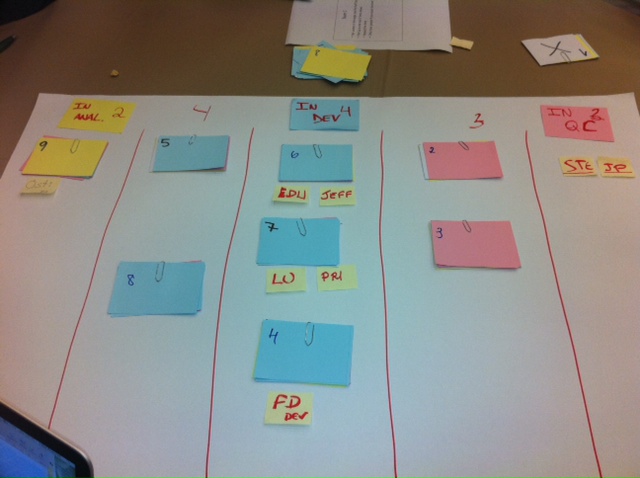

We were able to finish the activity, but unfortunately, we did run short of time and could not analyze the results. I did promise this blog post for the attendees to share a few notes, photos and the Cumulative Flow diagram of each team.

At the end of the activity, I had the following data points:

  • Team A completed 10 Stories
  • Teams B and C had similar results: both finished 11 Stories
  • Team D seemed like the less chaotic team, and did the highest number of stories: 12 Stories

On subsequent blog entries, I will share the feedback from the session (thanks!), upload activity photos, and the Cumulative Flow Diagram created by each team. If you were at the session and have either photos or the excel file, please send it over.

Here is the feedback I collected from this workshop.


Tuesday, June 14, 2011

The 1000 Students Challenge

I've been doing agile coaching and consulting since 2003. First internally, later external working for various consulting organizations all over the globe. Well, one of my key experiences was, that before being able to teach agile, the mind needs to be freed from old school thinking. Think about a major reset. I won't say that everything taught is unusable, however, it is often used in the wrong context. There is more and more evidence that better ways of working -- especially, in the field of knowledge work -- do exist and agile is one of them.
Since 2010 I am a Professional Scrum Trainer with Scrum.org and teach various Scrum classes. Depending on the mixture of the audience and their background, it does take some time to free their minds from the old believe system and make them receptive to the new ideas. Better late then never, but for a two day course it is not as effective as it could be. Often, the AHA-effect happens late on day two.
After having given the PSM to a bunch of very stubborn senior managers, I decided that a there must be a better way to change the world of software development. That night, the 1000 student challenge was born. The idea is simple - don't try to change the head of the system, but have future agile thought leaders join the system and move up the ladder.
My vision is to teach 1000 students in Scrum and hope that they will change the world of tomorrow.

On May 28-29 2011 I gave me first Pay It Forwad - Professional Scrum Master (PIF-PSM) training at the University of Bern. I had the pleasure to work with 13 bright students, willing to come in on a Saturday and Sunday to learn about agile and Scrum. The training is essential for free - however USD 100 per student is required to cover the assessment fees and the course material.

13 people joining the workforce with a an agile mind set. It is a small beginning, nevertheless I really feel good about it.

If you are interested in doing this at your local university please contact me and we work out a way to spread Scrum at your place as well.

987 more to go ...


.

Thursday, April 28, 2011

PM Dojo

The first PM Dojo! At least, it was the first PM Dojo I have heard about. For this reason, I want to share it.

Inspired by many Dojos our colleagues have been doing at Thoughtworks Brazil, we –PMs and BAs-- decided to give it a try.

Here are the slides we have used:

PM Dojo Thouhgtworks Brazil - 2011 April 27

The Dojo took one hour. It started with a quick overview, followed by a round table (fishbowl style), and a closing exercise.

The round table had 4 chairs. One chair was kept empty, available for whoever wanted to join the conversation. When someone joined the table, someone else on the table (typically the one either sitting longer or less involved on the current conversation) would leave the table. The other participants were standing or sitting near the table. This is the fishbowl style.

For the closing exercise, we used the ROI (Return on Investment) and Feedback exercise.

Basically I asked the participants to write down in a post-it feedback about the Dojo. Then, I told them to place the post-it on the ROI radar.

The ROI radar have a line going from very little ROI :( -- to very high ROI :) ++. The ROI question was:

For this last hour that you have spent here in this Dojo, how do you measure the return on your investment (of your time)? I am supper happy; this was really worthy my time: goes on top; the opposite goes on the bottom.

Below is the result from the ROI and Feedback exercise.

I left the Dojo with a good feeling. Now, I will check the feedback, chat with some of the 20+ folks that participated on it, and start thinking about the next one.

Thursday, March 24, 2011

Scrumban em Porto Alegre

A ThoughtWorks será anfitriã do primeiro treinamento de Scrumban em Porto Alegre.


Do Scrum ao Kanban: Novas perspectivas em gestão Ágil de projetos de software

Recentemente, a comunidade ágil, tem voltado a atenção para o Kanban, muitas vezes usando como referência o Scrum (método ágil predominante). Neste treinamento Rodrigo de Toledo e Alisson Vale explicitam esse caminho do Scrum ao Kanban, também conhecido como Scrumban, revelando quais os ganhos que podemos colher. Conceitos como fluxo contínuo, foco, visibilidade e melhoria contínua são reforçados. Acreditamos que o Kanban traz um novo patamar de amadurecimento no mundo ágil.

Dias:
1º e 2 de abril. Das 9h às 18h.

Local:

Escritório da ThoughWorks (localizado na PUC-RS, Tecnopuc, predio 99, 14º andar)

Maiores informações:

http://www.scrumban.com.br


Thursday, March 17, 2011

Scrum.org Trainer Meeting in Boston


On March 14th and 15th Scrum.org had organized a get together for their trainers. On the agenda were several topics. The most prominent was to start updating the existing PSM material. Scrum.org added two new trainings. PSTM (Professional Scrum Team Member) and PSPO (Professional Scrum Product Owner). The PSTM is the fundamental training, teaching the basics of Scrum; no prerequisites are required. Whereas the PSPO covers the Product Owner site of Scrum. Those additions are making it worthwhile to look into the existing PSM content and to see what can be removed and what should be updated. On the other hand it was long overdue to meet the other trainers in person.
Needles to say that these were two intense days of ongoing discussions and creation of new ideas. When great minds think alike it is amazing what the outcomes are. Overall, it has been very energizing.
Since the complete PSM material is rather large we weren't able to complete it. Now, our colleagues will pick up our work at the next trainer gathering in Brussels and carry on the baton. Hopefully they will not only carry but also inspect our work and improve it.
So stay tuned for an improved PSM training - a training even going deeper and addressing the more challenging problems of today’s Scrum Masters.
Thanks to my fellow trainers at Scrum.org, I feel honored to call you my friends and to be part of this.

Friday, February 18, 2011

Apple, Scrum and the importance of a good Product Owner

My job as a coach and trainer gets me around quite a bit. It is always thrilling to meet new people and to learn about all types of industries. During those encounters, I often get asked how companies like Google, Apple and Facebook do work. Before I left the USA for Switzerland, I used to work for ThoughtWorks out of their San Francisco office. During that time I had the chance to peek under the covers of a couple of those well known bay area players. Pretty much all of those companies are agile, not necessarily in a Scrum or XP way but they surely value their people with trust and autonomy. Yes, these are exactly the most important ingredients for self-organization.
The one company which I never even put a foot in was Apple – I drove by twice a day – but 1 Infinite Loop is a black box for me. So how does Apple do what it does? How could this company recover like a phoenix from the ashes? I admire Steve Jobs. He does magic on stage when showing Apple’s latest products. He has a strong personality and there are quite some stories floating around about his famous tantrums. So, how did this man turn around Apple? Well, to be honest I don’t believe that it was a one man show completely; however this one man is in the exact right position.
Let me explain how I see the role of Steve Jobs though Scrum glasses.
Each Scrum team consists of one ScrumMaster, a Team and one Product Owner. For larger projects you can have more Scrum Teams working together, which is called a Scrum of Scrums. A company wide Scrum of Scrums enables the company to do agile product portfolio management , which is crucial to overcome the stasis of annual plans. At the very top of those Scrum of Scrums, you have THE Product Owner, the over-Product Owner, the one person responsible for what gets developed in which order. Steve Jobs is exactly this person at Apple. Sure, he is CEO and has absolute power. However, in contrast to other CEOs which are too far removed from the details, Steve Jobs is exactly interested in these details. He had the whole iPhone redesigned because it had more than one button. He decides to accept or not to accept the products. He gives the acceptance criteria and he has to like what he sees or it does not see the light of the day.
To me this confirms that one of the most critical roles in a Scrum Team is the Product Owner. Sure, the best Product Owner with a lousy team will not succeed either, but a great team can only be on top of the game with a great Product Owner.
The success of a project depends on the Product Owner, its role but more importantly the person, and definitely NOT how good or detailed the requirements are. A good Product Owner enables the Team to rise above and make a great product the right way.

Tuesday, February 1, 2011

PSD (Java) Train the Trainer

From Jan 20th until 28th the first PSD (Java) Train the Trainer gathering took place. It was held in Sao Paulo/Brazil. The idea behind train the trainer is to horizontally scale up our effort to teach good and emergent coding practices to developers. With more trainers there is more exposure. Let’s cross the chasm!
The training was two-fold. First Giovanni Bassi from Lambda3 held a two day PSM class to reinforce the agile fundamentals of Scrum. The potential trainers are by no means new to Scrum, most of them are veterans with years of field experience. The PSM class helped to set a common foundation and understanding within the group. The following Monday the PSD class started. One week of four mini sprints, each one with sprint planning, development, daily scrums, review and retrospective (details). The idea is to communicate what real agile development using Scrum by applying XP practices feels like. I strongly believe that once a developer has drunk the Cool-Aid, they will always try to get that feeling back. There is no way back - they are addicted, addicted to best of breed development practices. The five days are laced with theoretical blocks to explain the underlying ideas and principles. So, it is a great mixture of hands on and theory.
In contrast to the PSD (.Net) course, the Java one is less tool focused and more on the craft. Our backlog management is done with paper on a pin board and bugs are handled through the backlog – no issue tracking system. All used software is open source. (Eclipse, SVN, Ant,Hudson, Cobertura, EclEmma, Mockito, …). A low tech story board with paper is still the most effective information radiator.
The students were great, throughout they were agile-savvy and smart people. It was fun to work with them and during late night discussions I had the chance to learn from them as well.
Brazil was the perfect setting for this training. There is a vibrant agile community and Lambda3 is a driving force. I am looking forward to see more inovation coming from this part of the word. Globalcode was an excellent host and very forthcoming.
We named ourselves the Boi Tátá Team. (Boi Tátá is a mythical Brazilian creature)
There will be more PSD (Java) Train the Trainers. If you are interested please get in contact with Scrum.org.